
Deep freezer breast milk storage
Storing breast milk in a deep freezer is one of the most convenient ways for breastfeeding parents to build a long-term milk supply, reduce waste, and prepare for returning to work, traveling, or sharing feeding responsibilities.
But how long can breast milk stay frozen? Is a chest freezer better than a regular refrigerator freezer? And does freezing affect the nutritional value of breast milk?
How Long Can Breast Milk Stay in a Deep Freezer?
Best quality
6 months
Recommended storage target
Acceptable maximum
12 months
At 0°F (−18°C) or colder
According to the Centers for Disease Control and Prevention (CDC), breast milk can be stored in a freezer at 0°F (−18°C) or colder for up to 12 months, although using it within six months is recommended for the best quality.
The American Academy of Pediatrics (AAP) also recognizes deep-freezer storage for up to 12 months, with dedicated deep freezers often operating at approximately −4°F (−20°C) or colder.
Breast milk storage temperature chart
| Storage location | Temperature | Recommended duration |
|---|---|---|
| Room temperature | 77°F (25°C) or colder | Up to 4 hours |
| Refrigerator | 40°F (4°C) or colder | Up to 4 days |
| Regular freezer | 0°F (−18°C) or colder | 6 months best; up to 12 acceptable |
| Deep freezer | −4°F (−20°C) or colder | 6 months best; up to 12 acceptable |
| Thawed milk in refrigerator | 40°F (4°C) or colder | Up to 24 hours after completely thawing |
These are conservative CDC-based recommendations for healthy, full-term infants. Babies who are premature, hospitalized, or medically vulnerable may require different handling rules.
Important: A deep freezer does not automatically make breast milk safe beyond 12 months. Storage time is calculated from the original expression date, even if milk is transferred between freezers.
Why Use a Deep Freezer for Breast Milk?


A dedicated deep freezer offers several advantages over a standard kitchen freezer.
More consistent temperatures: Chest freezers typically experience fewer temperature fluctuations because they are opened less frequently and cold air tends to remain inside when the lid is raised.
Greater storage capacity: A dedicated unit lets parents keep hundreds of milk bags organized without competing for space with frozen food.
Better long-term organization: Milk can be divided into dated batches, making it easier to rotate inventory and prevent older supplies from being forgotten.
Fewer accidental temperature changes: Less frequent access reduces repeated warming of stored packages.
Emergency flexibility: A well-stocked chest freezer can preserve frozen contents for a significant period during an electrical outage, provided it stays closed.
However, a deep freezer is not essential for every breastfeeding family. A properly functioning regular freezer at −18°C or colder can also safely store breast milk for up to 12 months under CDC guidance.
Chest Freezer vs. Upright Freezer vs. Regular Freezer

- Chest freezer — best for long-term bulk storage
Excellent for large milk supplies, with stable temperatures and efficient use of interior space. The drawback is that finding a particular bag can require moving storage baskets.

- Upright freezer — best for organization
Shelves and drawers make dated milk batches easy to find. Upright models are convenient in smaller rooms but can experience more air exchange when the door opens.

- Refrigerator freezer — best for occasional storage
No additional appliance is necessary. It works well for smaller milk reserves, provided it consistently maintains 0°F (−18°C) or colder.
Freezer type comparison
| Feature | Chest freezer | Upright freezer | Fridge freezer |
|---|---|---|---|
| Bulk capacity | Excellent | Good | Limited |
| Milk organization | Good with bins | Excellent | Fair |
| Temperature stability | Often excellent | Good | Variable |
| Space efficiency | Needs floor space | Smaller footprint | No extra space |
| Separate purchase required | Yes | Yes | No |
| Best use | Large milk stash | Organized reserves | Small supplies |
Overall recommendation: For parents who pump frequently and want to maintain several months of milk reserves, a small chest freezer is generally the most practical choice. For occasional storage, a regular freezer is usually sufficient.
Best Containers for Freezing Breast Milk
Choosing the right storage container is just as important as maintaining the correct freezer temperature.

- Breast milk storage bags
Best for saving freezer space. These flexible, purpose-designed bags can be frozen flat, stacked, and organized into dated groups. Use bags specifically manufactured for storing human milk, rather than ordinary food storage bags.

- Glass storage bottles
Best for reusable storage. Glass is easy to clean and does not absorb odors. Choose freezer-safe bottles with tight-fitting lids, and leave sufficient space for expansion.

- Food-grade plastic containers
Lightweight, durable, and convenient for frequent pumping. Select BPA-free containers intended for food storage and compatible with freezing.
Storage container comparison
| Container | Main advantages | Main limitations |
|---|---|---|
| Milk storage bags | Compact, lightweight, easy to stack | Usually single-use; puncture risk |
| Glass bottles | Reusable, easy to clean | Heavy, bulky, breakable |
| Plastic containers | Lightweight and reusable | Take up more freezer space |
| Silicone containers | Reusable and flexible | Higher upfront cost |
For most families building a large milk stash, breast milk storage bags offer the best combination of convenience, capacity, and organization.
The CDC recommends milk storage bags or clean, food-grade glass or plastic containers with secure lids.
How to Freeze Breast Milk Properly: Step-by-Step

Step 1: Wash your hands and prepare clean equipment
Wash your hands with soap and water and make sure the breast pump components and storage containers are properly cleaned.

Step 2: Divide milk into small portions
Freeze approximately 2–4 ounces (60–120 mL) per bag or the amount your baby typically drinks during a feeding. This reduces waste.

Step 3: Label each container
Write the expression date and milk quantity on every bag. Use a permanent, freezer-resistant marker.

Step 4: Freeze bags flat
Remove excess air without spilling milk, seal securely, and lay the bags flat on a clean tray. Follow the manufacturer’s fill limits and allow space for milk to expand.

Step 5: Organize frozen milk
Once frozen, place the bags upright in labeled containers. Keep the oldest milk near the front so it is used first.
For maximum quality, freeze breast milk promptly when you know it will not be used within the next few days.
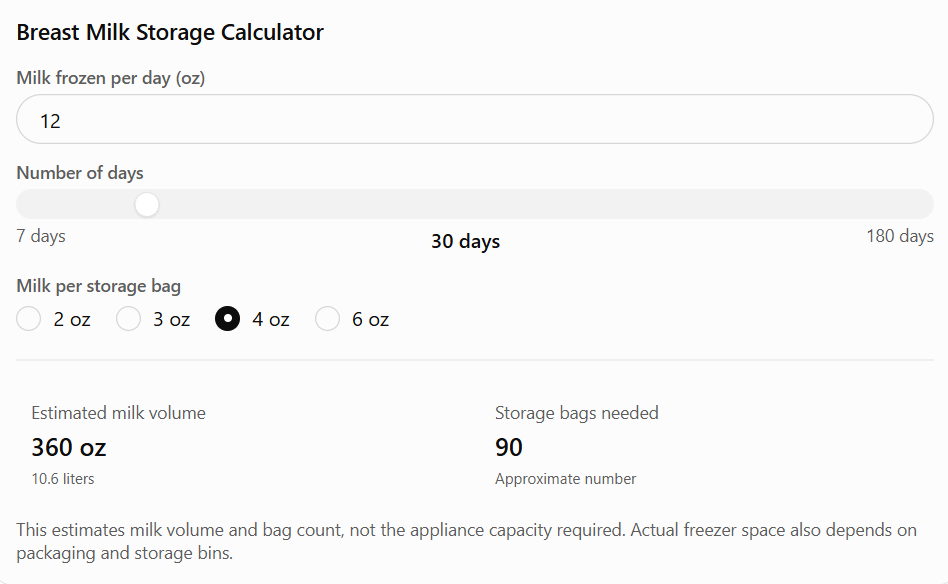
Breast Milk Freezer Storage Calculator
Planning how much space to reserve for milk is easier when you calculate your expected supply.
Use this calculator to estimate how much expressed milk you plan to freeze and how many storage bags you may need.
How to Organize a Deep Freezer for Breast Milk


Effective organization reduces food waste and makes feeding preparation easier.
A practical method is the first in, first out (FIFO) system: use the oldest safely stored breast milk before newer batches.
Organize milk by week or month, keep an inventory, and record how many bags are added or removed.
Sample breast milk freezer inventory
| Date expressed | Quantity | Storage location | Status |
|---|---|---|---|
| October 1, 2026 | 8 bags | Basket A | Frozen |
| October 5, 2026 | 12 bags | Basket A | Frozen |
| October 10, 2026 | 10 bags | Basket B | Frozen |
| October 15, 2026 | 9 bags | Basket B | Frozen |
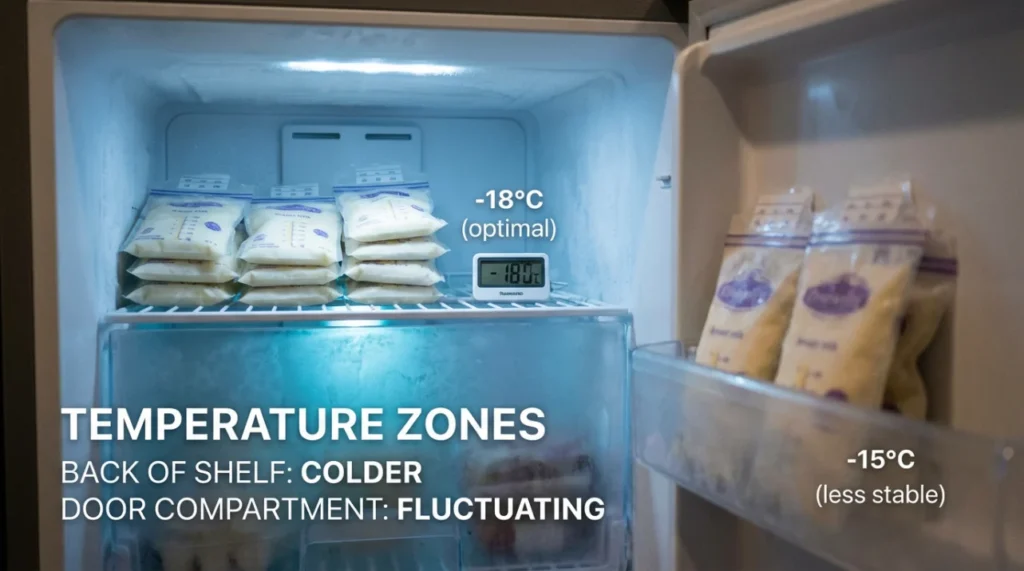
Keep milk toward the back or center of the freezer, away from the door or lid opening when possible.
How to Safely Thaw Frozen Breast Milk
Freezing is only half the process. Proper thawing is essential to maintaining breast milk safety.
Recommended thawing methods
- In the refrigerator: Place a frozen bag or bottle in the refrigerator overnight. Use the milk within 24 hours after it has completely thawed.
- In lukewarm water: Submerge the sealed container in a bowl of lukewarm water, making sure water cannot enter the milk.
- Under running water: Hold the sealed container under lukewarm running water until the milk thaws.
Breast milk does not have to be warmed before feeding. It can be served cold if the baby accepts it.
Never use a microwave, boiling water, or direct stovetop heating. Microwave heating can create hot spots capable of burning a baby’s mouth.
Thawed breast milk safety chart
| Situation | What to do |
|---|---|
| Fully thawed in refrigerator | Use within 24 hours |
| Milk warmed or brought to room temperature | Use within 2 hours |
| Baby drank some milk but left some in bottle | Use or discard within 2 hours after feeding |
| Completely thawed milk | Do not refreeze |
| Milk still contains ice crystals after partial thawing | May be refrozen under CDC guidance |
Gently swirl the milk to redistribute separated fat. Separation into creamy and watery layers is normal.
Does Freezing Breast Milk Destroy Nutrients?
Freezing breast milk can change some of its biological properties, but properly frozen breast milk remains a valuable source of nutrition.
During frozen storage, certain living cells, enzymes, and immune-related components may become less active or decrease over time. The extent of change depends on storage duration, temperature, and handling.
The AAP explains that some natural milk enzymes, particularly lipases, can continue breaking down milk fats during storage. This may produce a soapy or unusual taste that some infants dislike.
Fresh vs. frozen breast milk
| Characteristic | Fresh breast milk | Frozen breast milk |
|---|---|---|
| Main macronutrients | Preserved | Largely retained |
| Living cells | Present | Some may be reduced |
| Immune-related activity | Generally higher | Some activity may decrease |
| Flavor | Original | May change during storage |
| Convenience | Requires near-term use | Supports long-term planning |
Freshly expressed breast milk may retain more of its original biological activity, but correctly stored frozen breast milk remains an appropriate feeding option.
What Happens During a Power Outage?
One of the biggest concerns with deep freezer breast milk storage is an unexpected loss of electricity.
According to the CDC:
48 hours
Approximate cold retention for a full, unopened freezer
24 hours
Approximate cold retention for a half-full, unopened freezer
These estimates depend on the freezer, room temperature, insulation, and how often the door is opened.
To protect your breast milk during an outage:
- Keep the freezer closed.
- Use an independent freezer thermometer, ideally with an alarm.
- Keep frozen milk grouped together.
- Consider a backup power supply for prolonged outages.
- Check for remaining ice crystals once power returns.
Milk that still contains ice crystals may be refrozen. Fully thawed milk that is still refrigerator-cold should be used within 24 hours or discarded. If its temperature history is uncertain, discard it.
Common Breast Milk Freezing Mistakes
Even a high-quality deep freezer cannot compensate for unsafe handling.
| Common mistake | Better approach |
|---|---|
| Overfilling milk bags | Leave expansion space |
| Storing milk in the freezer door | Use the back or center |
| Forgetting expression dates | Label every portion |
| Mixing warm milk into frozen milk | Cool fresh milk before combining |
| Thawing with a microwave | Use refrigerator or lukewarm water |
| Refreezing fully thawed milk | Use within recommended limits |
| Not checking freezer temperature | Monitor with a thermometer |
| Freezing oversized portions | Store smaller feeding-sized amounts |
Another frequent misconception is that breast milk needs to be frozen immediately after pumping. In fact, freshly expressed milk can be refrigerated at 40°F (4°C) or colder for up to four days. However, freezing it sooner is preferable when long-term storage is planned.
Is Buying a Dedicated Deep Freezer Worth It?
A separate deep freezer is useful for some families but unnecessary for others.

Pros
- More space for months of expressed milk.
Better organization of frozen batches.
Potentially more stable temperatures.
Reduced need to rearrange household food.
Convenient for exclusive pumping or returning to work.

Cons
- Additional purchase and electricity costs.
Requires floor space or a suitable storage area.
Chest models may be difficult to organize without bins.
Milk can be lost during prolonged outages or equipment failures.
Large frozen reserves are not essential for successful breastfeeding.
Our review: Which setup is best?
Small dedicated chest freezer
Best for bulk storage
A compact chest freezer offers an excellent balance of capacity and temperature stability for families storing large amounts of breast milk. Look for an adjustable thermostat, easy-to-clean interior, storage baskets, and an independent temperature alarm.
Compact upright freezer
Best for accessibility
An upright freezer is a better fit when frequent access and organization are the top priorities. Adjustable shelves and drawers make it easier to rotate dated milk bags.
Existing kitchen freezer
Best budget choice
For families freezing only a few bags each week, using an existing freezer is generally the most economical option.
What to look for when choosing a freezer
Prioritize consistent temperatures of −18°C (0°F) or colder, adequate usable capacity, dependable construction, and easy temperature monitoring.
Automatic defrost can improve convenience, but temperature stability is more important than convenience features alone.
A freezer with a power-loss or high-temperature alarm provides additional protection for valuable stored milk.
READ ALSO: How To Hide a Pregnancy Bump?
