
Protecting Sleep with Slumberpod
Traveling with a baby or toddler can be exciting, but sleep is often the part parents worry about most. A bright hotel room, unfamiliar surroundings, siblings sharing the same room, or parents wanting to stay awake after bedtime can quickly disrupt a child’s normal sleep routine.
That is exactly the problem the SlumberPod is designed to solve.
SlumberPod is a portable blackout canopy that fits over many travel cribs, playards, mini cribs, toddler cots, and compatible toddler mattresses. Rather than replacing the child’s crib, it creates a darker, more private environment around the existing sleep space.
What Is SlumberPod?
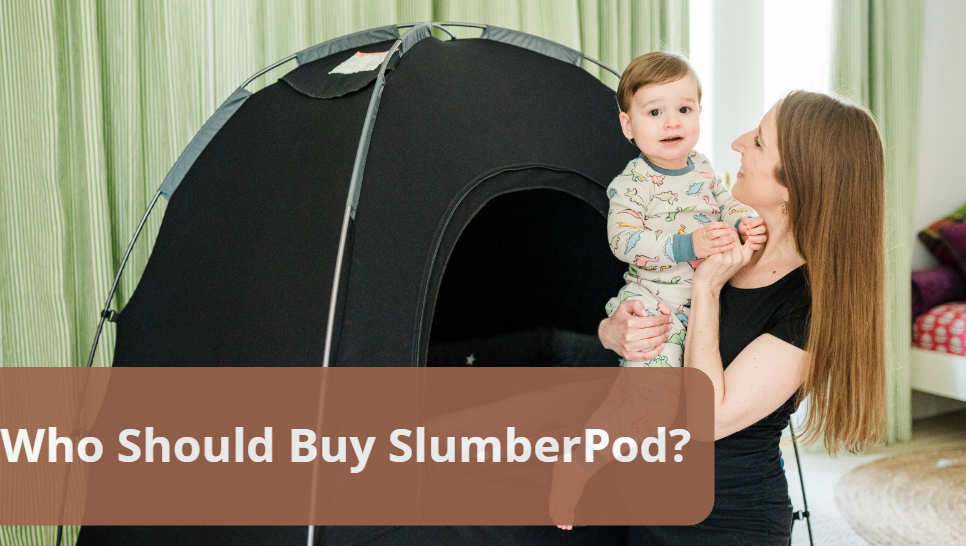
SlumberPod looks somewhat like a small indoor tent, but it isn’t actually a crib or mattress.
It is a bottomless blackout canopy. You assemble its poles, place the canopy over an appropriate sleep product, and zip the exterior closed to reduce incoming light.
That distinction is important.
Your baby still sleeps in the crib or playard underneath the SlumberPod. The SlumberPod itself does not provide the mattress or sleeping surface. The manufacturer recommends the product for children 4 months and older.
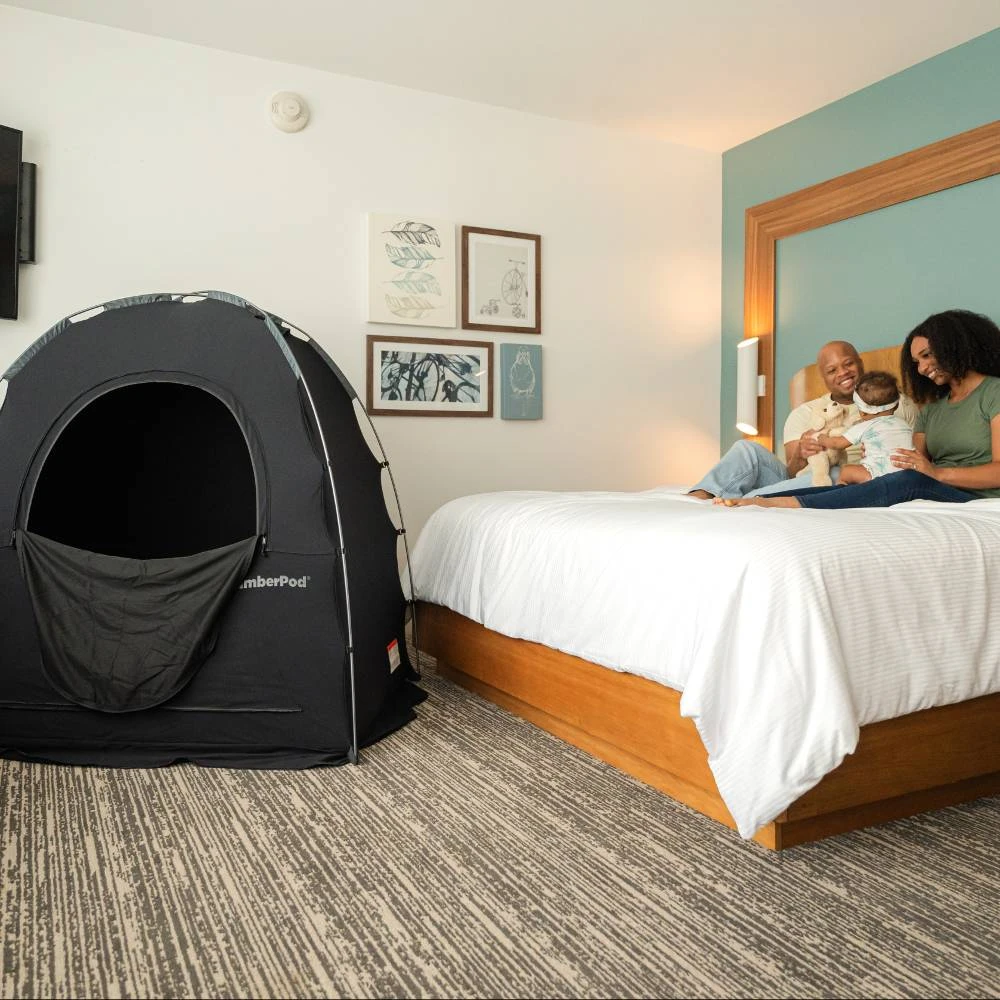
This approach can be especially useful when families have to share a hotel room.
Imagine putting your baby down at 7:30 PM in a hotel. Without some form of blackout solution, you may feel forced to turn off every light and spend the rest of the evening whispering.
With the SlumberPod covering the baby’s travel crib, parents can potentially continue watching TV, reading, working, or moving around the room while significantly reducing the light reaching the child.
How Dark Does SlumberPod Get?
Blocking light is the main purpose of the product.
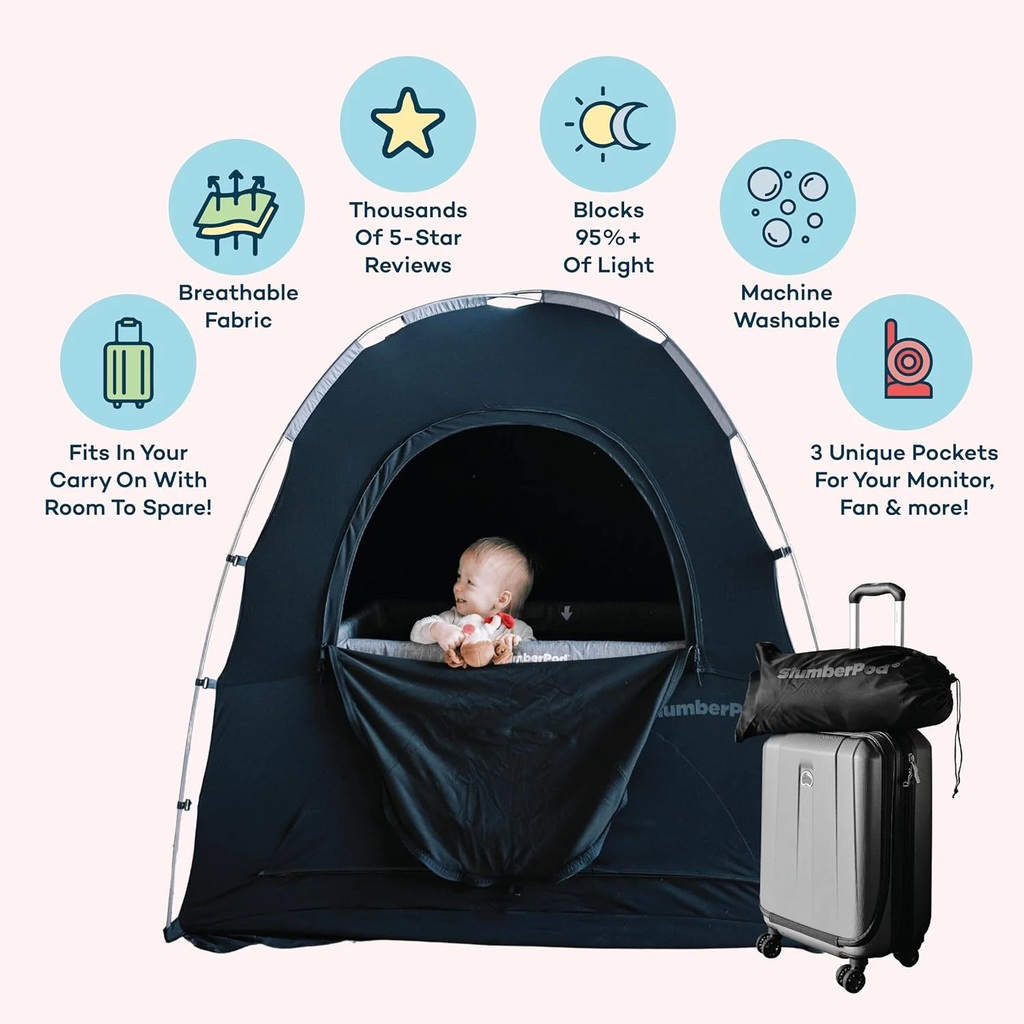
SlumberPod’s current product listing says its breathable, stretchable fabric blocks more than 95% of light.
This can be useful not only at night but also for daytime naps.
Hotel blackout curtains vary dramatically. Some work extremely well, while others leave large gaps around their edges. Vacation rentals can be even less predictable.
A portable blackout canopy means parents don’t have to depend completely on the room they’re staying in.
It can also help recreate a more familiar sleep environment. If a child normally sleeps in a very dark room at home, suddenly asking them to nap in a sun-filled rental bedroom may be difficult.
Current SlumberPod Size and Portability
One of SlumberPod’s biggest strengths is that it provides a relatively large enclosed area while packing into a small travel bag.
The current SlumberPod product listing gives the following specifications:
- Assembled: approximately 54 × 40 × 53 inches
- Packed: approximately 17 × 5 × 6 inches
- Weight: approximately 5.5 pounds
It comes with the canopy, two support poles, a carrying bag, and instructions.
Five and a half pounds isn’t nothing when you’re trying to travel light, but it’s considerably more manageable than transporting additional furniture or trying to construct a temporary blackout setup at every destination.
Its narrow packed shape also makes it relatively easy to place inside luggage.
What Fits Inside SlumberPod?
SlumberPod is designed to work with many popular travel cribs and playards.
The manufacturer currently lists compatibility with playards measuring up to approximately 44 inches long, 30 inches wide, and 38 inches tall.
Examples listed by SlumberPod include products from brands such as Graco, BabyBjörn, Bugaboo, Nuna, UPPAbaby, Baby Trend, Maxi-Cosi, 4moms, Guava Family and others. It can also fit various mini cribs and, for older children, selected toddler cots and inflatable mattresses.
Before buying one, however, I would compare the exact dimensions of your sleep product with SlumberPod’s current compatibility information rather than assuming every travel crib will fit.
Setting It Up
SlumberPod uses two shock-corded support poles.
The general process is straightforward:
Extend the poles, feed them through the appropriate fabric sleeves, secure them into the canopy corners, and then place the assembled SlumberPod over the crib or playard.
It is similar to assembling a small camping tent.
The manufacturer specifically recommends practicing the setup at home before traveling. It also warns against forcing or excessively bending the poles during assembly.
That is good advice.
The first time you assemble any pole-supported tent structure can feel slower than expected. You don’t want your first attempt to happen at 9 PM in a hotel room while holding an overtired baby.
Set it up once or twice before your trip and the process should become much more intuitive.
Ventilation
Putting a dark fabric canopy over a baby’s sleep space naturally raises an important question:
What about airflow?
SlumberPod uses air-permeable polyester/spandex fabric and incorporates ventilation panels into the canopy. The current design also includes pockets that can accommodate optional fans.
According to SlumberPod, the product underwent additional independent testing evaluating CO2 rebreathing. The company says the evaluating physician classified it as presenting a low hazard for CO2 rebreathing, including testing with ventilation flaps closed and without a fan.
The optional fan therefore shouldn’t be viewed as something required to make the product safe. It is primarily intended to improve comfort and circulation, particularly for children who sleep warm.
SlumberPod should nevertheless be used indoors in a climate-controlled and well-ventilated environment.
It isn’t meant to turn a hot room into a cool one.
Using a Baby Monitor
Another clever feature is the dedicated baby-monitor pocket.
Parents can position a compatible camera outside the sleeping area while still getting a view through the pocket toward the child.
This is particularly useful because simply placing a camera inside a dark canopy may create problems with cords, positioning, heat, or visibility.
There is one caveat.
Some cameras with autofocus may focus on the clear material of the monitor pocket rather than the child. SlumberPod recommends checking the instructions for your specific monitor and confirming that its manufacturer permits this type of placement.
Always test the camera before bedtime rather than assuming the picture will be usable once the room becomes dark.
SlumberPod and Safe Sleep
This is the most important part of the review.
For babies, a SlumberPod should never be treated as permission to modify the actual sleeping area underneath it.
The U.S. Consumer Product Safety Commission recommends that babies sleep on their backs on a firm, flat surface in a crib, bassinet or play yard designed for infant sleep. The sleeping area should remain bare other than a properly fitted sheet.
The American Academy of Pediatrics gives similar guidance: babies should sleep on a firm, flat surface in a compliant crib, bassinet, portable crib or play yard, without loose blankets, pillows, toys or other soft objects.
So the safest way to think about SlumberPod is:
The crib provides the safe sleep space. SlumberPod provides darkness and privacy around that sleep space.
Do not add mattresses, pillows, blankets, positioning devices, mattress toppers or other objects simply because the crib is covered.
Also keep the entire SlumberPod away from window-blind cords and other potential strangulation hazards.
Temperature Considerations
Parents sometimes assume that because a product has ventilation, temperature doesn’t matter.
It does.
SlumberPod advises using the canopy in climate-controlled indoor conditions and notes that temperatures inside may be roughly 1–2°F warmer than the surrounding room.
That means you should dress your child based on the real sleeping environment rather than automatically using the same clothing or sleep sack you use at home.
If the hotel room feels warm, adjust accordingly.
An optional fan can improve air circulation, but it doesn’t replace proper room temperature management.
Where SlumberPod Is Most Useful
SlumberPod makes the most sense for families who travel frequently.
Hotel rooms are probably the clearest use case.
It is also useful for:
- Vacation rentals
- Grandparents’ houses
- Family visits
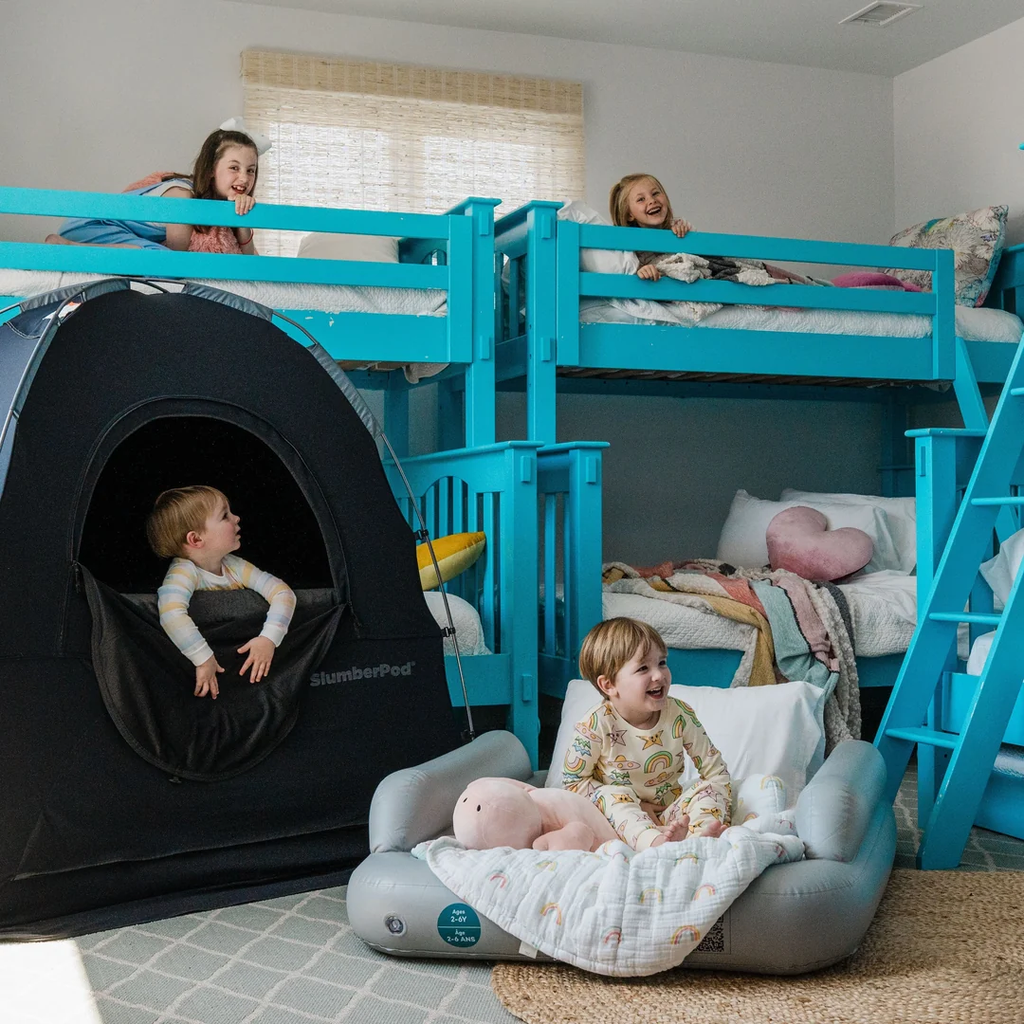
- Room sharing with siblings
- Cruises
- Daytime naps in bright rooms
- Temporary housing
- Families living in small apartments where parents and children share bedrooms
It can even be useful at home if two children temporarily need to sleep in the same room.
The major benefit isn’t simply darkness.
It is separation without requiring a separate bedroom.
What SlumberPod Does Not Do
There are a few limitations worth understanding before spending the money.
First, it does not reduce sound nearly as dramatically as it reduces light.
If you’re watching an action movie two feet away from a sleeping baby at full volume, SlumberPod isn’t going to create a soundproof bedroom.
A white-noise machine may help mask moderate household noise, assuming it is used appropriately.
Second, SlumberPod doesn’t automatically make a child sleep.
It can create conditions that are more similar to the child’s normal sleeping environment, but overtiredness, jet lag, illness, schedule changes and unfamiliar surroundings can still affect sleep.
Third, you still need a suitable crib, playard or age-appropriate sleep surface.
The SlumberPod isn’t a replacement for one.
Current Price
As of September 2026, SlumberPod’s official U.S. website lists the standard SlumberPod at $199.99.
A SlumberPod package including the company’s fan is listed at $219.99.
That isn’t cheap for what is essentially a specialized blackout canopy.
Whether the cost makes sense therefore depends heavily on how often you’ll use it.

Pros
- The strongest feature is simply how effectively the concept solves a real travel problem.
Instead of trying to tape garbage bags over hotel windows, hang temporary blackout curtains, hide the crib in a bathroom, or spend every vacation evening sitting silently in darkness, you bring a consistent sleeping environment with you.
The compact packed size is another major advantage.
I also like that it doesn’t require altering the child’s actual crib or playard. The bottomless structure goes around the sleep space rather than becoming the sleep surface itself.
The monitor pocket, ventilation system and optional fan pockets also show that the product has evolved around the practical issues parents experience when sharing rooms with young children.

Cons
- Price is easily the biggest disadvantage.
At around $200, occasional travelers may struggle to justify it.
You also have another roughly 5.5 pounds of equipment to pack.
Setup requires some practice, and parents who strongly dislike tent-style pole assembly may find it less convenient than they expected.
Another consideration is space.
Although SlumberPod packs small, once assembled it occupies more room around the travel crib. That can matter in extremely small hotel rooms.
And finally, while it solves the light problem very effectively, it doesn’t eliminate noise or guarantee that a child will maintain their normal sleep schedule while traveling.
Is the Fan Worth Buying?
For a standard SlumberPod, the current price difference between the regular version and the fan bundle is about $20.
For families who frequently travel to warmer climates, I think the fan package is the more practical configuration.
It provides additional circulation and flexibility without adding much to the overall purchase price.
However, it’s worth repeating that SlumberPod states the fan is an optional comfort accessory rather than a requirement for safe operation.
Who Should Buy SlumberPod?
SlumberPod makes the most sense if you:
Travel several times per year with a baby or toddler.
Frequently share one hotel room with your child.
Have a child who sleeps significantly better in darkness.
Need reliable daytime naps while traveling.
Visit relatives where a separate nursery isn’t available.
Have siblings sharing sleeping spaces.
In those situations, it can be one of those products that seems expensive initially but gets used repeatedly.
Who Can Probably Skip It?
If your child easily sleeps in bright environments, you always book accommodations with multiple bedrooms, or you travel only once every few years, the cost becomes harder to justify.
Portable blackout curtains may be enough if your only problem is sunlight through windows.
And if you already have reliable blackout conditions wherever your child sleeps, SlumberPod isn’t solving much of a problem.
Final Review
SlumberPod isn’t essential baby gear for every family.
But it solves a very specific problem unusually well: creating a dark, private sleeping environment for a baby or toddler when the family has to share a room.
The current version is lightweight enough for travel, packs into a relatively small bag, fits many popular travel cribs and playards, includes dedicated ventilation and monitor features, and can continue being useful as a child transitions from a playard to certain toddler sleeping arrangements.
Its biggest downside is the $199.99 price.
For families who rarely travel, that may be excessive.
For families taking frequent trips with a light-sensitive baby or toddler, however, the ability to preserve bedtime and nap routines while still using the hotel room after the child falls asleep can make SlumberPod much more valuable than its simple design initially suggests.
Just remember that the blackout canopy is only one part of the sleep setup. Babies should still sleep in an age-appropriate, compliant crib or playard on a firm, flat surface with a fitted sheet and no loose bedding or soft objects.
Used that way, SlumberPod can be a highly practical tool for protecting sleep both away from home and anywhere families need to share sleeping space.
READ ALSO: What functions does Kitchen Helper have?
